Today’s Christian guided meditation is on bible verse 1 Corinthians 16:14.
Do Everything in Love
Want Support With Your Meditation?
Join our Christian Meditation Facebook Group.
Today’s Christian guided meditation is on bible verse 1 Corinthians 16:14.
Do Everything in Love
Join our Christian Meditation Facebook Group.
Today’s Lectio divina practice is on 1 Corinthians 16:14.
For instructions, please see Lectio Divina Instructions.
In this practice, we will read or listen to the verse, then meditate, pray, and contemplate the verse using three translations of the verse 1 Corinthians 16:14.
1 Corinthians 16:14
Do everything in love.
1 Corinthians 16:14
Let all your things be done with charity.
1 Corinthians 16:14
Let all that you do be done in love
If you would like support in your practice, I invite you to join our Lectio Divina group on Facebook.
This guided meditation focuses on Matthew 5:44, love your enemies. We’ll meditate on loving our enemies.
1 Corinthians 16:14 – Do Everything in Love

Other practices you may choose to engage in include Bible Journaling, Christian Guided Meditation, and Lectio Divina.
References
New International Version (NIV) Holy Bible, New International Version®, NIV® Copyright © 1973, 1978, 1984, 2011 by Biblica, Inc.® Used by permission. All rights reserved worldwide.

Seated meditation is what people typically think of when they think of meditation.
If you’re new to meditation or even if you’ve been meditating for quite some time, you may wonder to yourself: what is meditation?
In fact, after meditating for almost 20 years, I still ponder this question with great curiosity and I hope wherever you are in your experience, you will do the same.
Meditation is not a static experience, nor is it just a mental exercise. While many people start meditating in order to experience the many benefits of meditation, meditation is a process for unfolding the depths of who you truly are. It is a practice for nurturing the aspects of your highest self, while becoming aware of and transforming those things that block you from experience peace, love, and joy in your life.
Are you ready? Here’s what you’ll find on this page:
I think of meditation like a Christmas present I get to unwrap each and every day. But I didn’t always feel that way. When I first got it in my mind to practice meditation, I had no idea what to do. I’d sit in a cross-legged position and my mind would wander, my feet would fall asleep, and sometime even I would fall asleep.
So when you first begin meditation, you might keep in mind that at first, it may seem like nothing is happening. This is very normal. I never recommend meditating for long periods of time at this stage, because consistent practice of meditation is more important than how long you meditate. What that means is that it is much more beneficial to practice meditating for five minutes every day than to meditate for 2 hours but not touch it again for two or three weeks.
As your meditation practice deepens, you may experience a sense of peace and tranquility. You may find yourself relaxing into a deep space of awareness, where the feeling of your physical body drifts to the back of your awareness and you your mind becomes fully absorbed in your breath.
In this state, you may have spontaneous insights about yourself. You may become aware of some pattern of thought or behavior that’s been holding you back. Or if you’re working on a creative project, you may find your creative juices flowing in ways you never imagined. In fact, focusing your creative energies directly after meditating can be extraordinarily productive.
Many people may lead you to believe meditation is simply a mental exercise, or if you simply practice meditation, your life will be perfect and happy all the time.
In my experience, these things simply aren’t true. While meditation has many benefits, it’s so much more than just a mental exercise, and unfortunately, there can be negative effects to your practice. But once you understand what meditation really is, you will come to understand how and why you should meditate. So let’s talk about those things now…
I truly believe with all my heart that everyone should meditate. I believe this because of the struggles I’ve experienced in my life. I won’t lie and tell you that if you meditate, you’ll always be happy. What I will tell you is I often ask myself where would I be and what I would do if I didn’t have the practice of meditation to fall back on? And I often look at people in the world and wonder, how do you live? How do you get by? How do you survive without some spiritual practice to sustain you?
The truth is, I would be a personal and emotional wreck if I didn’t meditate. And I think if you look at most people in the world who are rushing through life, agitated, aggressive, angry, unhappy, regretful, apathetic, or depressed, you might agree that meditation is a positive alternative to some of the other things people turn to in order to decompress at the end of a hard day.
The truth is, life is hard. Life is full of unexpected difficulties. If you don’t prepare for the difficult times of your life before they arrive, when they do come, you’ll find yourself unable to cope. You won’t know how to handle your thoughts and emotions that arise from those difficult situations. No matter how strong your belief is, no matter how iron your will, you’ll find yourself wavering. And you will drown in the sea of the world.
At the least, what meditation provides is a life vest, but if you’re fortunate, a lifeboat. The practice of meditation is a staff upon which to lean. It provides you with real and practical exercises that allow you to walk through the fires of life. Whatever turmoil you may be experiencing in your outer life, meditation allows you the opportunity to maintain a strong center of calmness within. And from this place of calm awareness, you may just find that you can navigate life’s calamities much more easily.
Just as you may experience creativity in your seated practice of meditation, you may find creative ways to approach difficult situations, and avoid some of the pain and suffering that might otherwise befall you had you not prepared through your practice of meditation.
The instructions for how to meditate are really the simplest thing in the world to do. And yet, for most, the practice takes a lifetime to master. Here’s my 7-step method for meditation practice.
Step 1. Find a comfortable, quiet place to sit.
You don’t have to sit cross-legged. Just be comfortable.
Step 2. Close your eyes.
Allow your eyelids to relax and have a feeling that your eyes are sinking back to the back of your head. Some people find it beneficial to also focus as if you are looking at the back of your own eyelids.
Step 3. Focus on your breath.
Feel the breath as it moves in and as it goes out. Don’t try to control your breath; simply observe it as you breathe in and breathe out.
Step 4. Keep your body relaxed.
If you need to move or adjust your posture during meditation, do so slowly and gently.
Step 5. Invoke a higher power.
Meditation is not a solitary exercise. I always think of Michelangelo’s painting, The Creation of Adam. It is a wonderful painting, and for me, it shows the balance between grace and self-effort. Adam is reaching for God, and God is reaching for Adam.

Public Domain: https://commons.wikimedia.org/w/index.php?curid=15461165
Holding this type of attitude in your meditation can be very worthwhile. Think to yourself, I am reaching for God. And at the same time, hold the understanding that God is also reaching for you.
Step 5. Notice your thoughts.
When a thought arises in your meditation, you might say to yourself, “This is a thought.” Whether it’s a happy thought or a sad thought, it makes no difference. It’s just a thought. Do not judge it or indulge it. When a thought arises, simply notice that it has happened. In the beginning, it may take some time, and you may find your mind wandering from thought to thought before you catch your mind and notice what it’s doing.
If the sounds around you are distracting, allow them to be part of your meditation. Even as I write this, I am practicing meditation and the sound of cicadas outside my window aren’t going to go away. I cannot make them stop, or stop my ears from hearing them. Accepting that the mind is going to think and the world is going to make noise are part of the process and a wonderful opportunity for patience, non-judgment, and tolerance.
Step 6. Maintain an attitude of non-judgment.
It’s okay if you feel like meditation is difficult, or if you feel like you’re not doing it right.
Judging ourselves is something everyone does and everyone has to learn how to become free from. If your mind wanders, just notice that is what has happened and bring your focus back to your breath without berating or belittling yourself.
Sometimes, I used to have thoughts like, I can’t do this, or I’m so stupid, I’ll never get it. Those too are just thoughts. In the beginning, I gave them a lot of power, and I would move through my day feeling bad about myself and thinking I could never learn to meditate. This is something I imagine everyone probably goes through in their life to some extent, not just in regard to meditation. Your practice of meditation is an opportunity to become free from such thoughts, and all the other thoughts that may be
holding you back.
Step 7. Sit quietly for 5 minutes.
When you’re done meditating, gently open your eyes. Take a moment and thank yourself for spending time with yourself. Thank your higher power for guidance during your meditation. Practice each and every day to start. Don’t worry about trying to do more. Make your practice consistent first and notice how it makes you feel after practicing for one day, two days, seven days, then a month.

In addition to the 7-step method above, there are many other meditation methods and techniques. Here are seven additional types of meditation to consider when you’re learning about what meditation is.
Although I haven’t formally studied mindfulness meditation, I do use various meditation techniques to carry meditation into my day and help me stay connected with my morning seated meditation practice.
This includes mindfulness while performing daily tasks, such as taking a shower, washing the dishes, or vacuuming the floor. In these cases, meditation becomes the practice of being fully present with whatever you are doing, and not allowing the mind to wander off into some fantasy world of thought or emotion.

I also repeat the names of God. I highly recommend Christians become aquatinted with their Hebrew roots by learning the Hebrew names that describe God and help us to know God better. The same is true for the names of Christ.
Additionally, a rosary or rosary ring are a great way to keep your mind centered on God through prayer.
Many people I talk to ask, what is meditation used for or what is meditation good for? As I stated earlier, there are many benefits of meditation and any one of them is a great reason to start meditating. I’ve listed some of these below. Just do me a favor and keep in mind that meditation is so much more than just a stress reducer or a method for getting better sleep.
Meditation has many benefits and is good for a variety of conditions and situations, including:
Although there are countless verses within the Bible that mention the word meditate, there is no explanation I’ve found as to what meditation actually means or the method by which to achieve it. In addition, the explanations I have seen from various online
sources are just as unclear.
The emphasis for Christian meditation is generally to meditate on the Word of God. While I fully advocate for the study of the scripture, Bible journaling, and contemplation as ways to deepen our understanding and spiritual experience, I also feel it’s important to distinguish between methods.
It is important that meditation on the Word of God does not turn in to a mental exercise. While your mind is a powerful tool, I’m afraid it is simply unable to offer us the experience of meditation. That experience actually arises within your heart. As long as your head and it’s mental activity are in charge, what you’re doing is, in fact, taking yourself away from the experience of meditation.
Don’t get lost in a sea of thoughts. Learn to meditate fully. Then use that experience to access higher levels of understanding by holding a scripture verse within the space of your meditation, or by calling upon the Holy Spirit to guide your understanding of the scriptures through Bible journaling and contemplation.

Colossians 3:13 (KJV)
Forbearing one another, and forgiving one another, if any man have a quarrel against any: even as Christ forgave you, so also do ye.
I invite you to meditate upon this bible verse, journal about your experience, and share your thoughts, experiences, and insights below.

What agreement is there between the temple of God and idols?
“I will live with them
and walk among them,
and I will be their God,
and they will be my people.”
I invite you to contemplate this bible verse and hold it in your heart today.
New International Version (NIV) – Holy Bible, New International Version®, NIV® Copyright © 1973, 1978, 1984, 2011 by Biblica, Inc.® Used by permission. All rights reserved worldwide.
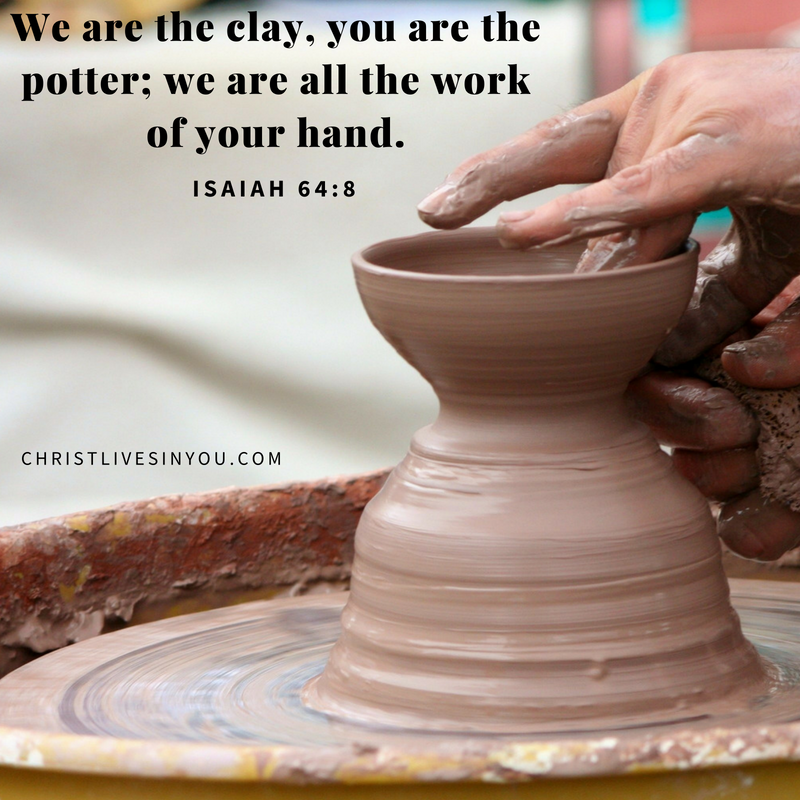

Isaiah 64:8 (KJV)
But now, O LORD, You are our Father; We are the clay, and You our potter; And all we are the work of Your hand.
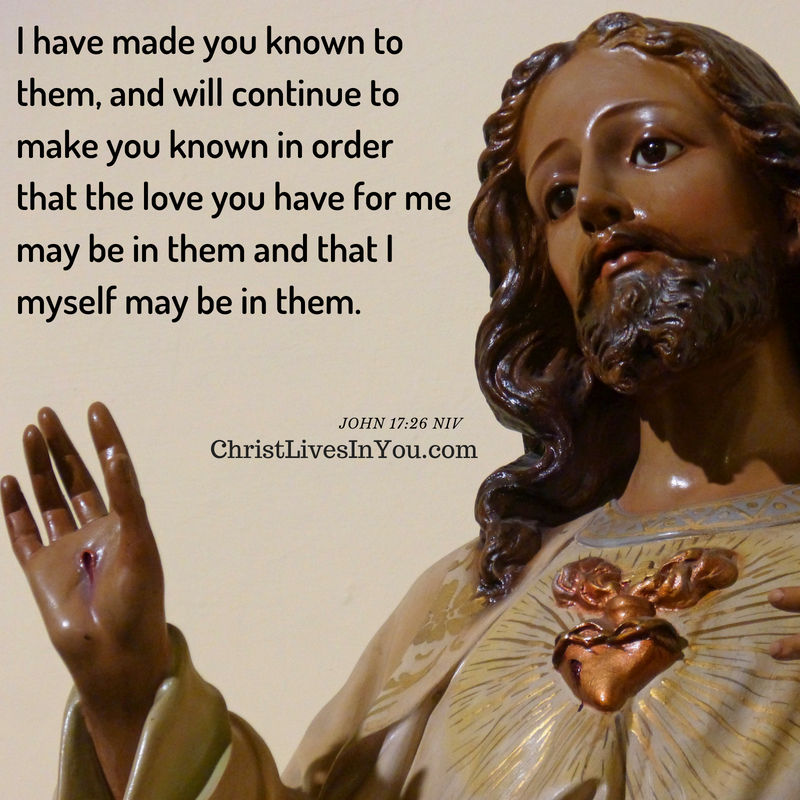
I have made you known to them, and will continue to make you known in order that the love you have for me may be in them and that I myself may be in them.”
I invite you to meditate on this bible verse today. Share your thoughts or reflections in a comment below

“Therefore I tell you, do not worry about your life…Look at the birds of the air; they do not sow or reap or store away in barns, and yet your heavenly Father feeds them. Are you not much more valuable than they?”



“Have I not commanded you? Be strong and courageous. Do not be afraid; do not be discouraged, for the Lord your God will be with you wherever you go.” Joshua 1:9
To view other translations, read Joshua 1:9 on BibleHub
Holy Bible, New International Version®, NIV® Copyright ©1973, 1978, 1984, 2011 by Biblica, Inc.® Used by permission. All rights reserved worldwide.